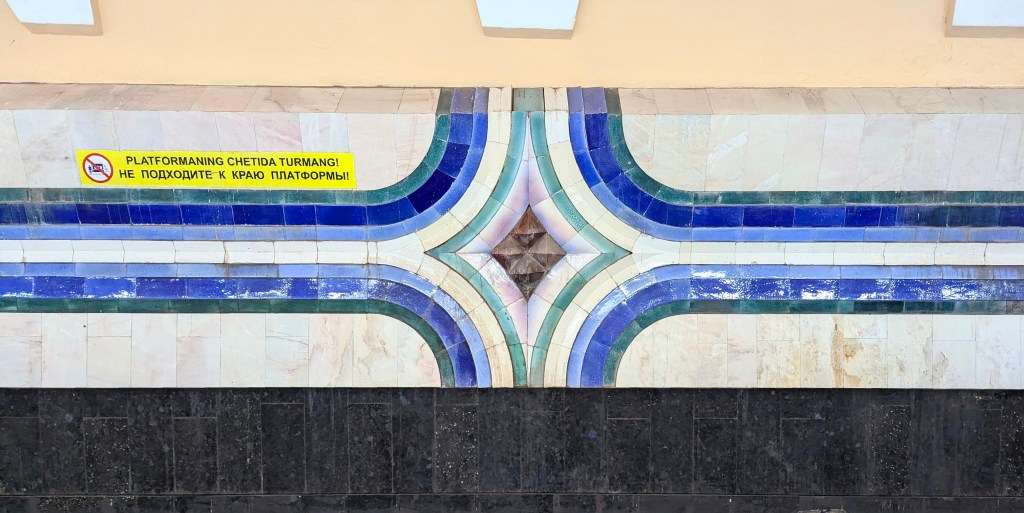
How (or why) do we assign a sense to a space?
I. Driving
My recent week in Uzbekistan was spent largely in my rental car, driving 1,200 km (750 mi) around the country’s capital of Tashkent then to the historic cities of Samarkand and Bukhara and back.
Beyond the heart-stopping cracks of rocks to my windshield in the wake of oversized trucks, and the scrapes of my bumpers against cement barriers and truly egregious potholes, I often found myself in a relative hush—white noise rushing in from my open windows, the muzzled doppler effect of cars whizzing past, my blinkers (albeit, infrequently…) tapping neon code to my fellow drivers.
As solo as driving alone is, and as private as the space feels among the clamor of everyday life, audio cues to others became a key element to my experience. It was as if I was constantly conversing.
Driving in small towns became a call and response between travelers, honking around corners of one-lane roads to assess each others’ positions as if by echolocation.
Traveling within large towns (or cities, as in the case of Tashkent) became a constant expression of intent; the first step towards hearing was opening the door for response—crafting an individualized communication which begot communication and so on and on.
Rather than just a witnessing or accepting or absorbing, every sprawl and stretch felt interactive. (Not least because zipping and merging between too-small byways was a necessity in streets where the right lane was used for parking, and the left was reserved for making U-turns. You can imagine the chaos across a two-lane road where both lanes are unusable.)
Infrastructure complaints aside, this is all to say: listening was the most engaged activity in which I partook across my Uzbek vacation.
It was pervasive. More than seeing or tasting or touching (of which there was plenty), hearing became the keystone of my experience—the foundation on which all other experience was built.
II. Metro
Parking my rental car in one of the many spaces you wouldn’t believe a car could be parked, I navigated Tashkent’s four metro lines, stopping at nearly every station.
See above for a visual exploration of the Tashkent metro, and below for an audio one.
III. Museum
Of course, the motif of audio designation and practice extended beyond transportation.
My experience within cultural institutions was earmarked with sounds exemplifying the ephemera on display. I am a big fan of personalized museum experiences: you choose your route, you select your ambiance, you make the experience your own. So it was a pleasure to choose which traditional instruments to listen to while exploring the State Museum of Applied Arts of Uzbekistan in Tashkent.
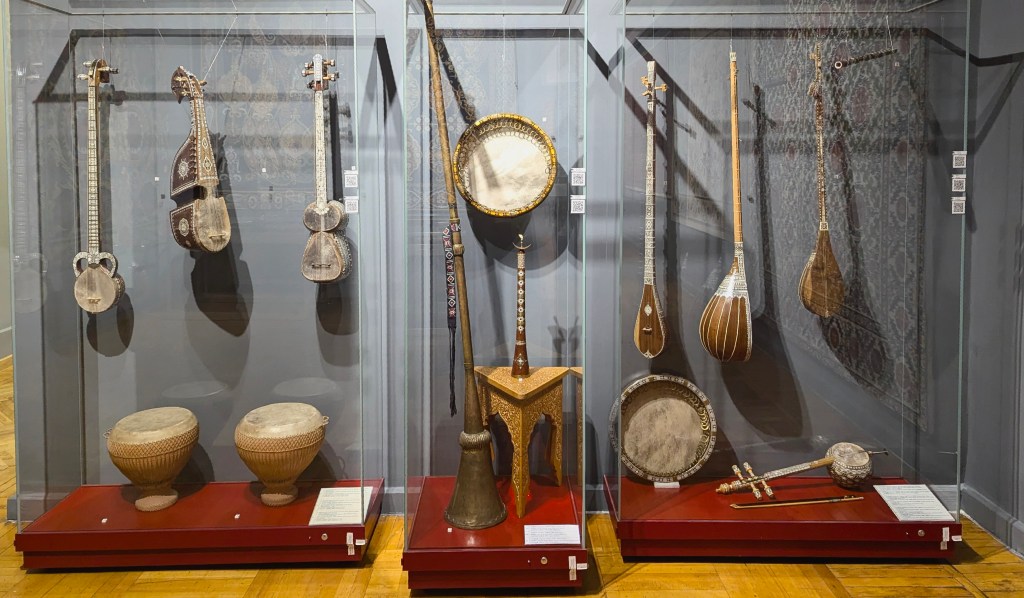
This display case featured a unique QR code for each traditional instrument. I listened to the songs consecutively, walking back and forth between the above installation and each subsequent element of display—cases and cases with jewels, weapons, sartorial ephemera, woodcarving, enameled boxes, embroidered tapestries, miniatures, and so on.
The QR codes and their linked files were an apropos technical solution to an interesting technical problem. It truly brought the objects to life:
Doira [doyra] – one of the oldest percussion instruments in the world; a circular drum face (at the bottom left of the case on the right).
The museum is one I would recommend—quaint enough to ward off museum fatigue but rich enough to grasp a broad array of the decorative arts for which Uzbekistan is dearly admired.
IV. Rave
Perhaps you can imagine my surprise whilst walking through the picturesque historic quarters of Samarkand, an ancient city renowned for its illustrious place along the Silk Roads, and seeing, in the distance, flashing technicolored lights. Hearing a thumping bassline grow louder as I wandered into the waxing and waning darkness, creeping along the previously-sleepy alleys speckled with closed coffee shops and souvenir markets.
After mounting confusion, I came to Registan Square, where a rave was seemingly underway.
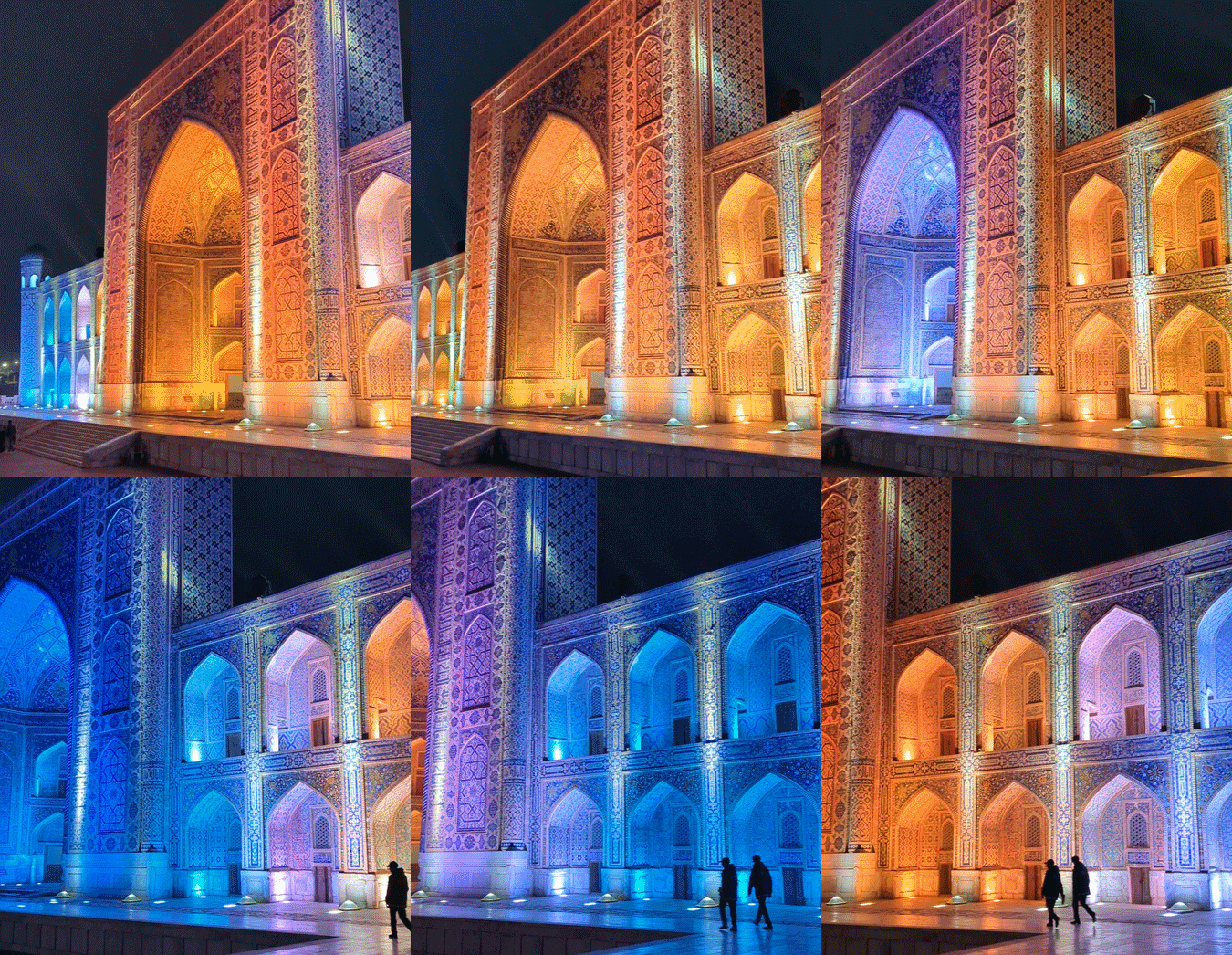
Imagine this scene
↜
With this song
↝
I have to assume this is not an everyday spectacle, but more of a weekend-and-holiday occurrence. I have to assume the target audience is confused yet intrigued tourists. Beyond that, I cannot assume, only question.
V. More driving
I returned to my drive, leaving one ancient city and embarking on a voyage to the next.
20 hours of white noise wasn’t quite titillating enough to keep me motivated to watch for the infamous aforementioned potholes. I scrolled through my recently downloaded playlists and came across a collection of Late Antiquity “bangers.” All was good and well until about half-way through the ballad below.
Safe to say, my adrenaline had been sufficiently piqued.
I did not finish the playlist.
VI. Birds
Further surprising sounds kept me engaged, especially the birds.
The birds!
I first heard a similar cacophony while driving on the freeway, and I was convinced a truck had overturned while carting a shipment of birds to a zoo or an exotic animal smuggling operation had gone awry.
VII. Church
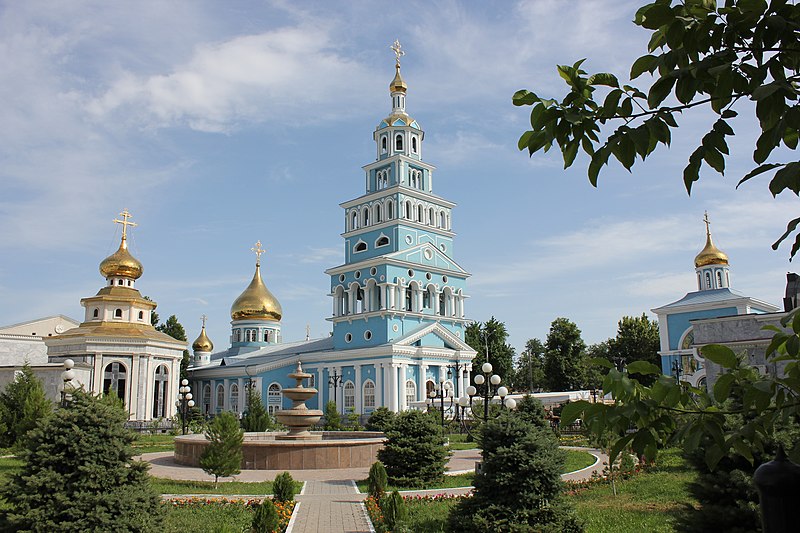
After what seemed like a lifetime, I arrived back in Tashkent. On one of my last nights in the city, I accidentally attended a Russian Orthodox church service. It was a similarly enlightening and engaging experience demarcated by sound (and massive quantities of incense).
I donned a 25.000 som headscarf and made the sign of the cross at seemingly-appropriate increments throughout the service. (I like to think I seemed to be from a foreign church rather than a foreign religion).
VIII. Airport
My trip came to a close at Tashkent’s international airport.
I have a friend who believes that flying is especially disorienting because your soul cannot catch up with your body; as exemplified in the legend of Icarus, humans were never meant to travel at such speeds and altitudes.
If that is the case, perhaps we can all be excused for our PTSD-inducing actions at airport check-in counters.
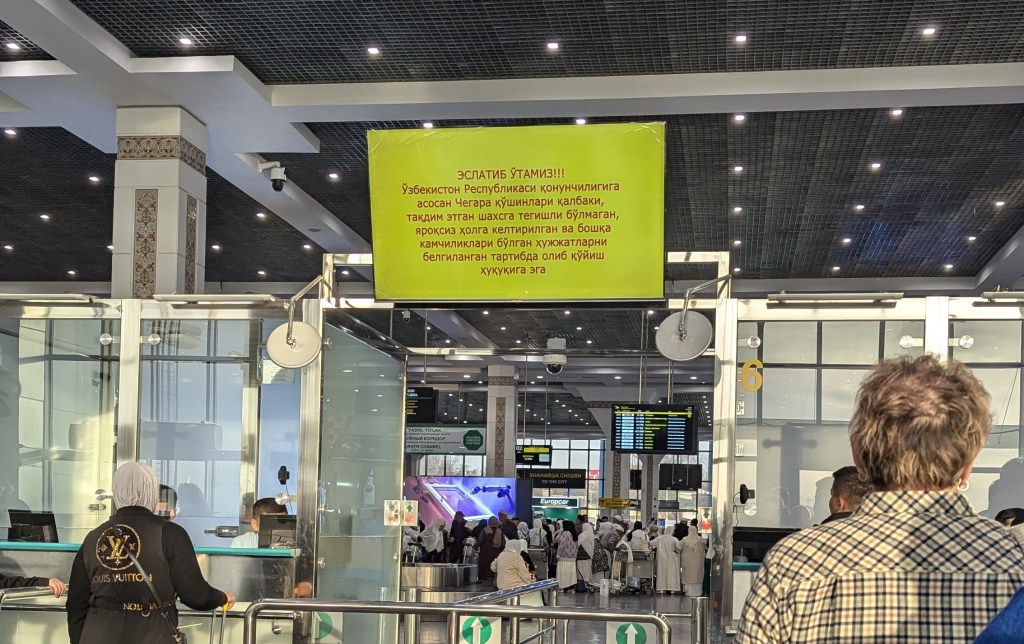
Does my current demonstrable jetlag indicate that my soul has yet to arrive home with me? How can I call or summon her?
IX. The question
Why associate Uzbekistan with sound above all other senses?
l suppose the better question would be: Why do we assign or designate specific senses to our surroundings, and why one sense over another? Is this just a controllable mediation between us and the unknown, or a way in which we can catalyze our memory-making amidst sensory overload?
I have no answers—only questions. Questions, and fading memories rap-tap-tapping at my brain.
 L.E. Brown
Leave a comment