UGO RONDINONE
2015-2016
BOULDERS, PAINT
LAS VEGAS, NEVADA
To touch a boulder is to hold the entire earth. To feel its strength and immovability, to burn from its heat or shirk from its chill, to scrape your soft flesh on its craggy sediment is to understand what is beyond human—that which has survived eons before us and will continue to do so for eons to come.
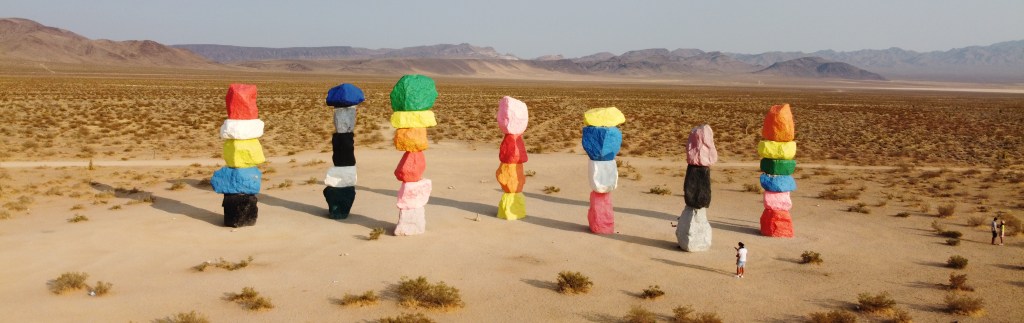
All rocks—big and small—exist in timelines that pay no debt to linearity; their beginnings and endings are one and the same. So what can one say about the boulders which Ugo Rondinone chiseled, transported, colored, and stacked into Seven Magic Mountains, the site-specific installation outside of Las Vegas, Nevada?
I have a hard time pinning these arguably linear and static vertical pillars to the concepts of linearity and staticity, just like I would with the individual boulders themselves. To witness them is to behold the above and beyond. It’s impossible to take in any of these “Magic Mountains” in a void, without coming into direct contact with the natural world from which they were born. Inevitably (considering you’re in the high desert) the sun is in your eyes, dust is swirling from passersby feet to your raw nose, and you can probably taste the dried brush scattering with the wind. However much these stacked boulders want to stand out from the environment, they blend in seamlessly with the surrounding domain. Just like you cannot escape the hovering technicolored mountains around you, you cannot escape the unforgiving, untamed landscape.
At first, the colors may seem out of place—ostentatious, even. But any untrained, yet curious, eye can find bubblegum pink, chartreuse, royal blue, and raving cochineal in their surroundings. And that is not to say one has to venture as far as downtown Las Vegas and its neon lights (though, admittedly, there is a wonderful and whimsical connection between the installation and the city’s hyper-manic reputation). I have seen desert flowers bloom in hues so bright I had to shield my eyes, wayward insects flash iridescent colors I could barely comprehend, and the reflecting sun pulse gold across the landscape in a way that would put cibola to shame. These seemingly unnatural colors surround the installation in ways that one can experience if only they pause and pay attention. And, yet again, the imposition of the boulders activates visitors within the environment, opening their eyes.
These seven monuments claim to represent the human element in contrast to the surrounding desert, and though I was at first hesitant to admit it, I agree. They are an intervention in the natural and a source of human contact (but the bustling crowds of visitors are usually more detrimental than they are good). But they’re also temporary, wearing a mask of permanence. They’re a cohort of whimsy in an otherwise unforgiving environment. They’re stationary, no matter how much dirt and detritus the wind thrusts at them; but they’re not impervious to time. They’re the concentrated vision of an ephemeral concept, something that can’t be pinned down to an explanation so neat and pretty and fun.
But they are very fun. It’s truly an enjoyable experience to traipse around these seven pillars, noticing their brilliance and feeling dwarfed in their shadows. It makes a good selfie backdrop and it looks damn good from above (see below). But I would argue that their value lies primarily in their function as a mirror, allowing us to see ourselves as grandiose monuments against a plain backdrop or a green screen, but also as a minute reflection of the grandiosity around us.
9.5/10. Fairly accessible, free to visit, mobility friendly. Highlight: seeing the boulders from afar as you drive towards the installation.
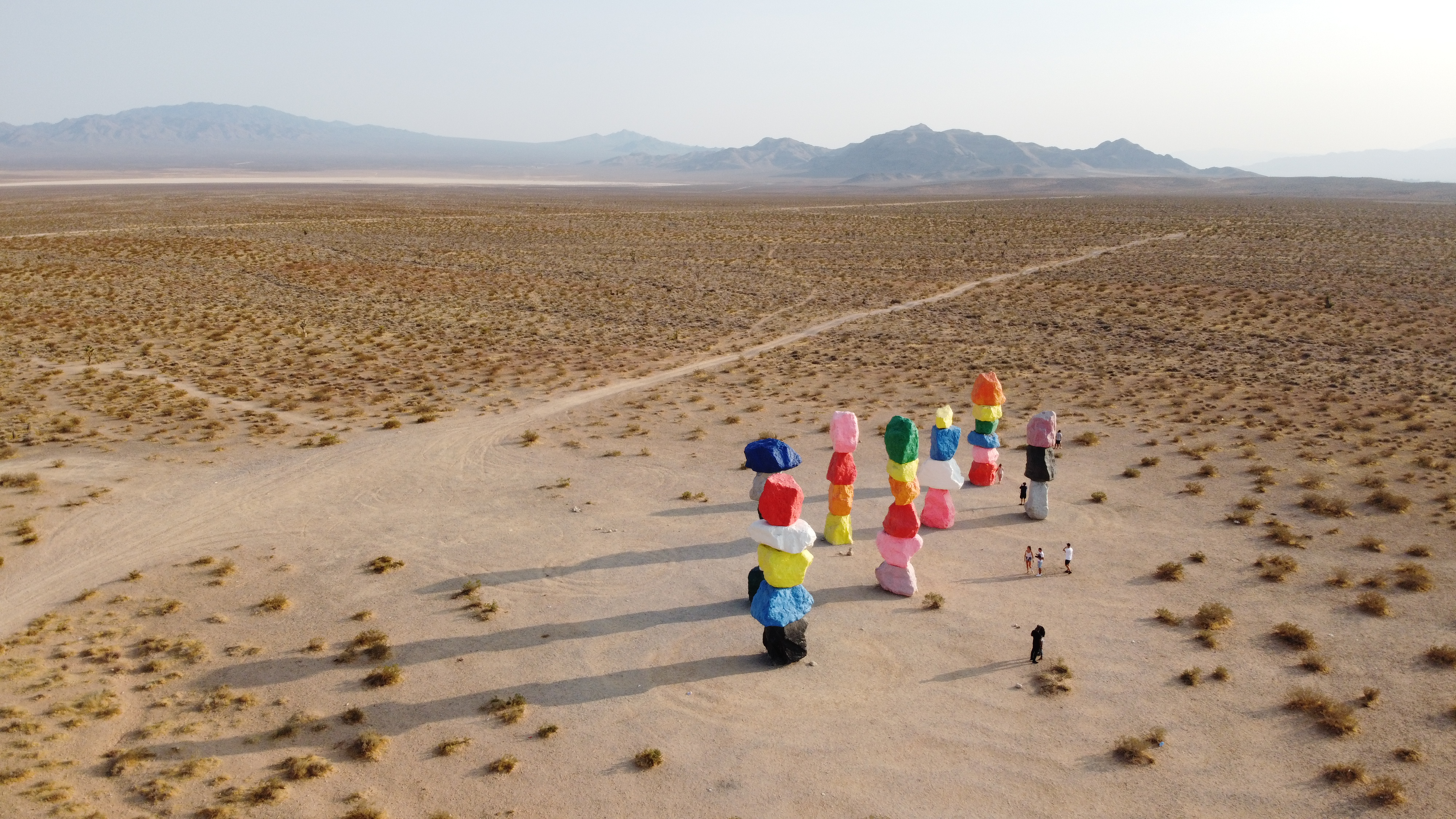
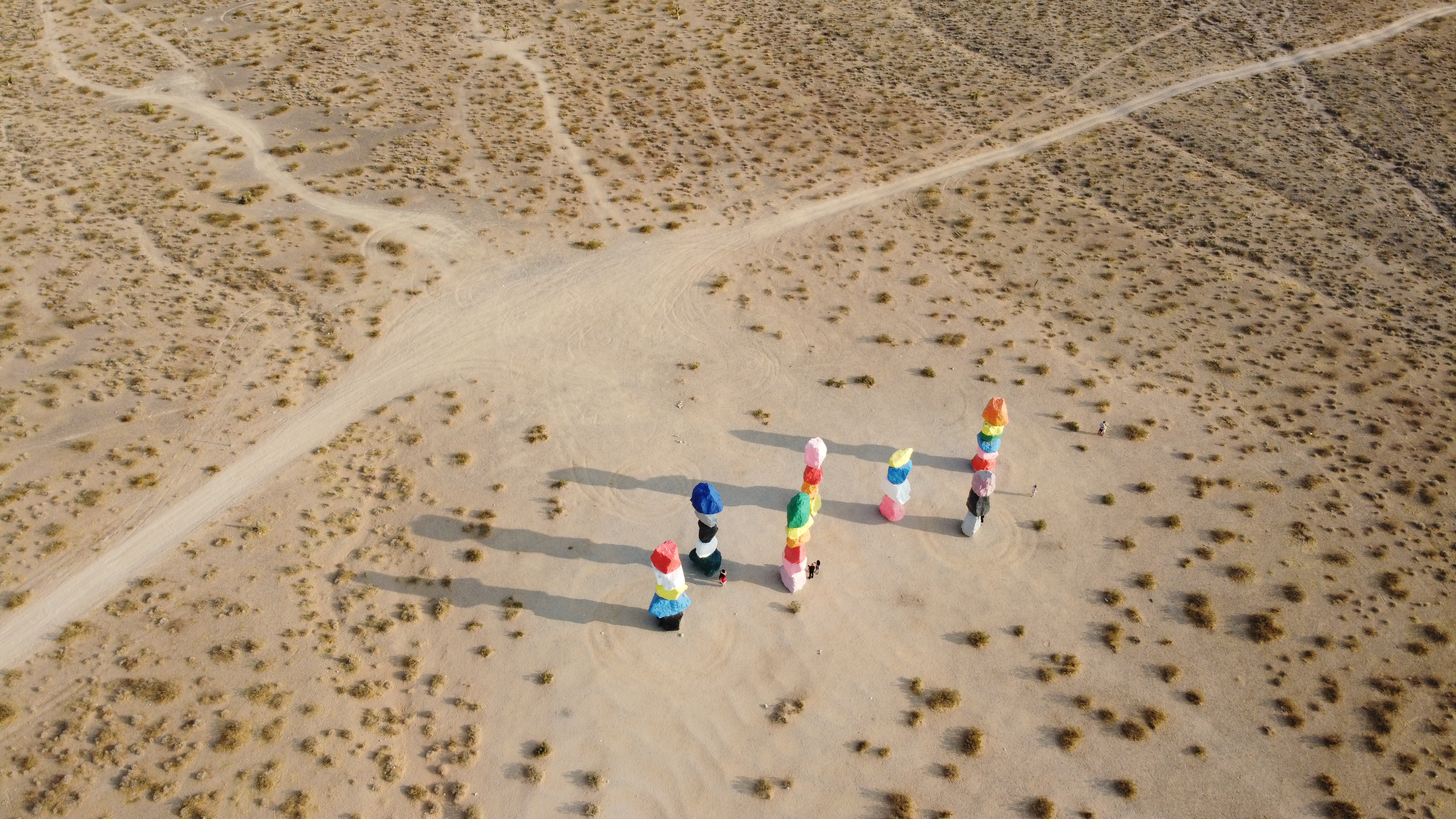
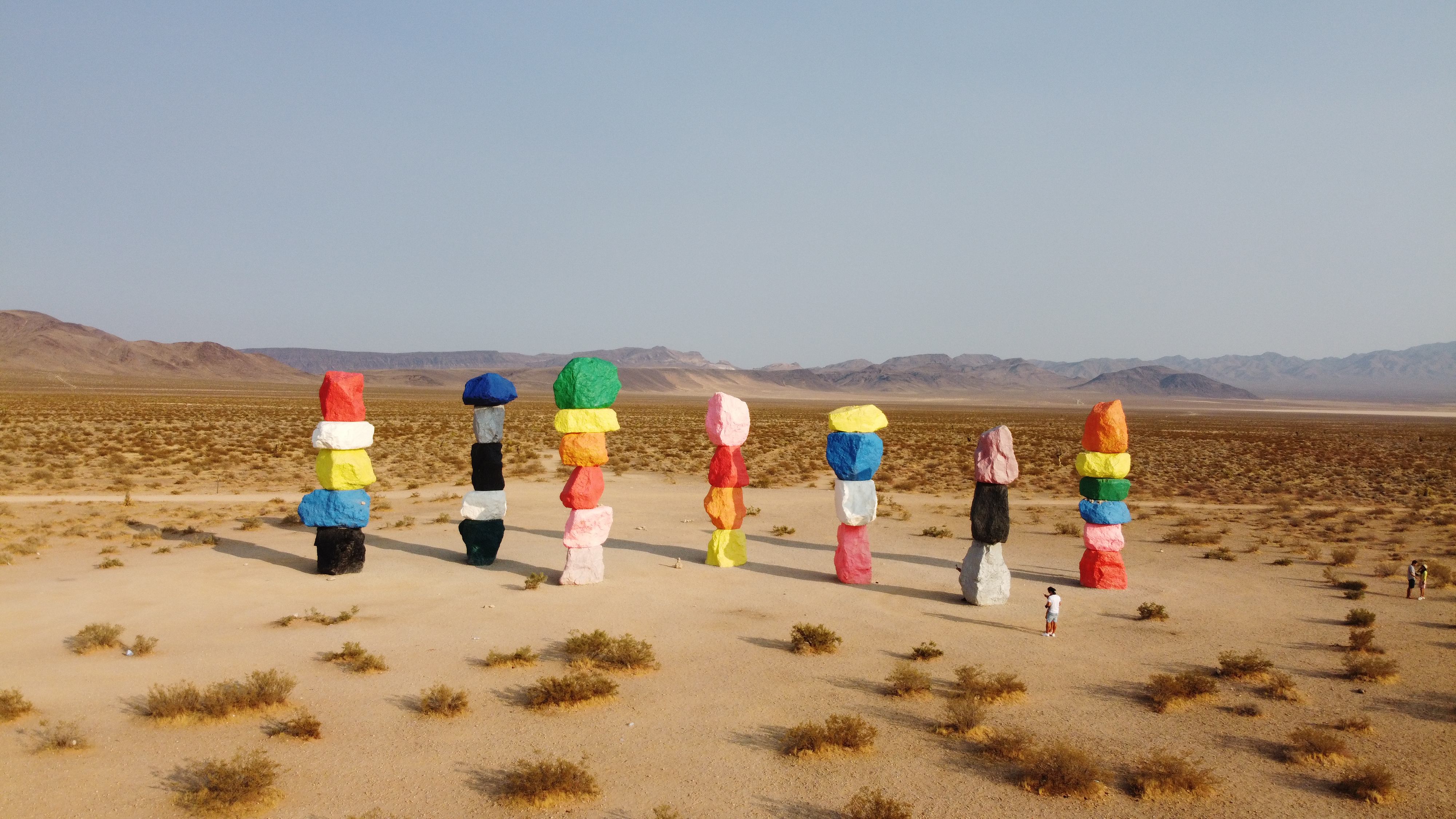
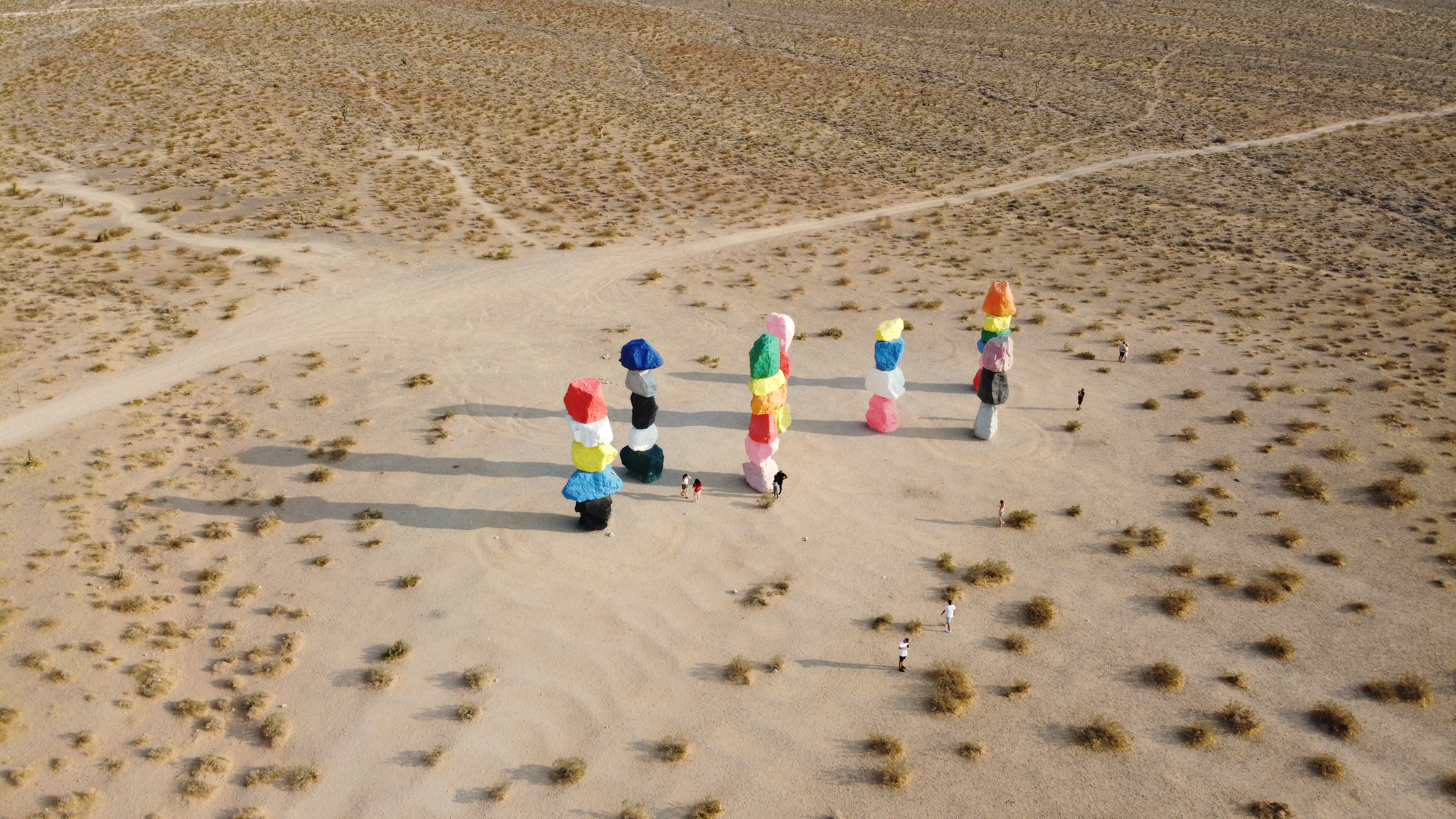
Photos by L.E. Brown, 2020
“Internationally renowned Swiss artist Ugo Rondinone’s Seven Magic Mountains is a large-scale site-specific public art installation located near Jean Dry Lake and Interstate 15, approximately ten miles south of Las Vegas, Nevada. Comprised of seven towers of colorful, stacked boulders standing more than thirty feet high, Seven Magic Mountains is situated within the Ivanpah Valley adjacent to Sheep Mountain and the McCullough, Bird Spring, and Goodsprings ranges of mountains. A creative expression of human presence in the desert, Seven Magic Mountains punctuates the Mojave with a poetic burst of form and color.
“Seven Magic Mountains was produced by the Nevada Museum of Art and Art Production Fund. The exhibition opened May 11, 2016, and was originally scheduled to be on view for two years. Due to the incredible success of Seven Magic Mountains since its opening, artist Ugo Rondinone has expressed a strong desire to explore ways to keep the artwork on view at its current site. The Producers continue to work on an extension plan that would enable Seven Magic Mountains to remain on view for several years into the future.” – sevenmagicmountains.com

 L.E. Brown
Leave a reply to Seven Magic Mountains: a visual essay – L.E. Brown Cancel reply